
Women's rights are human rights
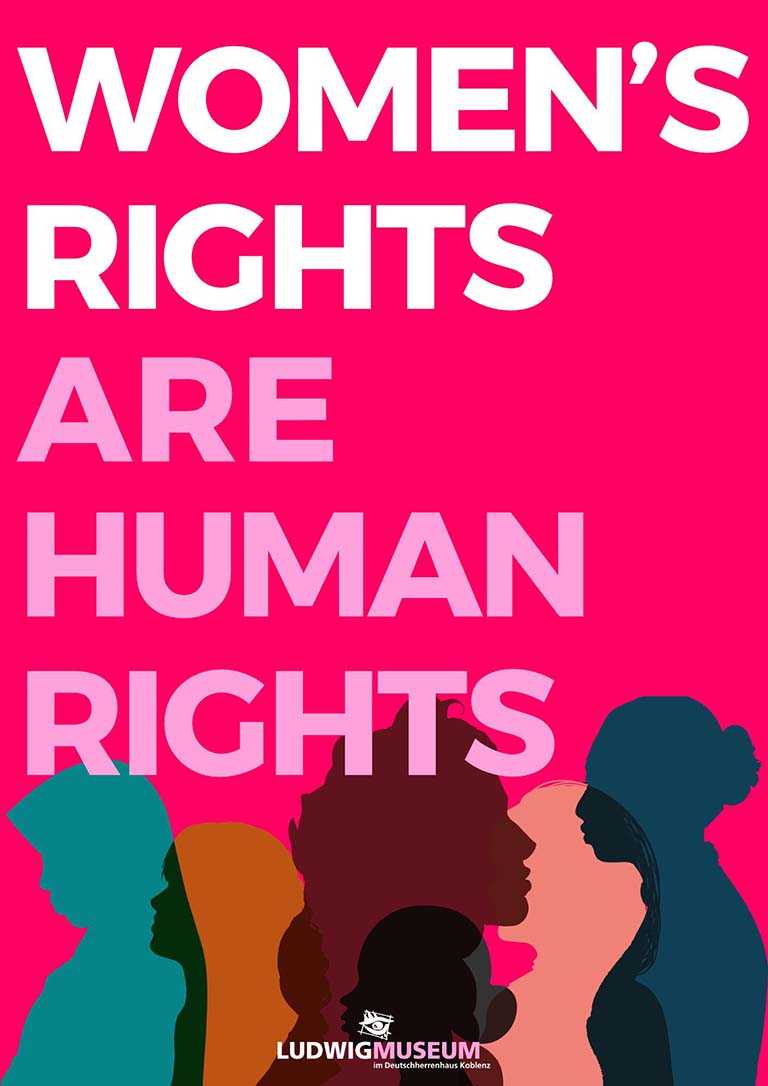
A contribution by the Iranian artist Jaleh Tavassoli. (engl. Version)
I will read you this personal text, because I think of myself as an artist under pressure, and I believe that what allows us to survive pressure is speaking about these different and yet similar experiences.
Being invisible and living under pressure is something every Iranian woman knows well and intimately — from the moment of her birth, at the most foundational layers of her existence, there are forces working to bring her mind and body under control. We live under a gender apartheid that is pure evil, built upon the pillar of misogyny, and fundamentally opposed to life itself — one that crushes and extinguishes every sign of vitality, beauty, or joy. This is something that maybe Western feminism has not always known how to hold — those aspects of lived female experience, of the relationship to the female body, that remain just outside its reach.
At the same time, art is how a person finds form and expresses herself. And when that is suppressed from the earliest days of life, something like a permanent struggle takes root inside you. How you talk, how you move, how you sit, how you dress — all of it, controlled. As a woman, as a neurodivergent person, and as an artist, you must rediscover who you are, and who you want to be, every single day — and keep it alive through expression — because at any moment it can be taken from you.
Two and a half months ago, when I arrived in Germany, I had come out of a suffocation. For some years I had not been able to work properly — there were constant obstacles, all of them with the same origin: the Islamic Republic. I had been summoned, interrogated, fined, threatened for my work, for being a woman who resists, for making paintings and writing that center the female body, its experience and its agency. And the effects of a physical injury I had sustained in 2022, during the Woman, Life, Freedom revolution, were still present in my body.
For two years I could not make art the way I needed to — and this at a time when I was living through events of enormous significance, both personally and collectively. My understanding of art had undergone a fundamental change. My desire to make art was stronger than ever. And yet, in practice, I could not work.
I was recently working on a project about the struggle of Iranian women that could not be mounted in Iran, so I tried to get out and came here. When I arrived in Germany I thought: now I have the space, and a different atmosphere, to move the project forward freely. But when you are Iranian, everything is unpredictable.
Things unfolded differently. A few days after I arrived, a new wave of protests began, and the terrorist regime occupying my homeland cut off the internet and all paths of communication and, in an unbelievable violence, massacred tens of thousands of people within only two days — abducting the wounded from hospitals, executing them, raping young girls in detention, killing detainees under torture. And as always, the world was silent.
It was in those days that I understood nothing meant what it had meant before. The connection between language and meaning had broken. Everything I had understood had collapsed. I was in a terrifying emptiness — and yet inside that emptiness I felt millions of thin threads reaching into me, threads that ran to every Iranian, connected to an enormous source of suffering and hope, and to an immense, unstoppable will to live. Those threads had all turned black. They were carrying something dense and heavy — like tar — into my stomach, my lungs, my heart, my blood, my soul. From a distance, I was physically bound to the pain of my homeland, searching for meanings that had gone missing, without a single familiar hand that shares the horror to reach for. I am grateful for the few German friends who found their way to me — I don’t know what shape that solitude might have taken without their support and kindness. but In that near-total solitude, I finally found my way of expression, I began to paint — almost non-stop — until the war began. The war, with all its terrifying and dark truths, which is, without question, the ugliest face of the human.
Before all of this, I thought that the pressure I lived under was a part of living in Iran, and things would be easier outside. But the pressure of this time was of an entirely different nature. more intense. And more corrosive. Truth was being slaughtered somewhere at a distance from me, and I had to keep my connection to it intact while my body was held in a kind of perceptual coma. This is the hardest thing I have ever done.
At the end, I want to compare the path of the Iranian woman’s struggle to a plant growing in a hostile environment. For both, movement is growth, and growth is unstoppable — it is the very meaning of living. Roots either navigate around stones or force their way through them, and growth continues. Bodies occupy space. Leaves extend outward. We Iranian women have stood on each other’s shoulders for centuries, rising up from the darkest and deepest layers of misogyny, building an immense tree of awareness and sisterhood that has cracked and broken the heaviest stones. That is what makes the pressure survivable.
And it is that truth — in a time as turbulent and chaotic as this one — that has shifted my understanding of art: away from something entirely personal, toward something personal in relation to collective experience and deep human connection.
Jaleh Tavassoli